The history of Internet Relay Chat is filled with independent networks built by people who simply wanted a place to communicate, build communities, play games, and meet others online.
Some grew into enormous international networks. Others remained smaller communities serving particular countries, interests, or groups of friends.
ZAIRC was one of those independent networks.
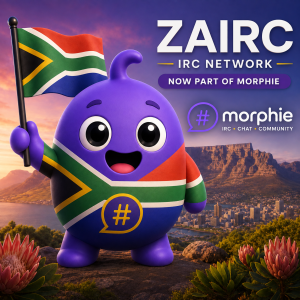
After years of operating as its own IRC community, ZAIRC has entered a new chapter in its history: the ZAIRC IRC Network has been acquired by Morphie.
Rather than allowing another piece of IRC history to disappear, Morphie is bringing ZAIRC into its growing network while preserving the ZAIRC name and its connection to the IRC community.
ZAIRC and the South African IRC Community
ZAIRC developed a reputation as a South African IRC network, providing users with a place to connect and chat through the familiar IRC protocol.
South Africa has a long history with IRC.
During the earlier years of the internet, IRC networks gave South African internet users something that social media would later make commonplace: the ability to instantly communicate with groups of people from across the country and around the world.
IRC was remarkably simple.
Users connected to a server, selected a nickname, joined a channel, and started talking.
Over the years, South Africa had its own IRC communities and networks. One of the better-known early examples was ZAnet, which connected South African IRC users during an earlier era of the internet.
As those older communities disappeared, newer networks continued the tradition.
ZAIRC became one of them.
Historical online discussions show users recommending ZAIRC after ZAnet was no longer operating, including references to ZAIRC channels dedicated to general conversation and trivia-style competitions.
Other historical IRC directories described ZAIRC simply and appropriately as:
“We’re a South African chat network.”
That description captures an important part of ZAIRC’s identity.
The ZAIRC Network
For years, the primary address associated with the network has been:
irc.zairc.net
Through that address, traditional IRC users could connect using IRC clients and participate in the network without relying on the large social media and messaging platforms that increasingly dominated online communication.
ZAIRC also appeared in IRC network directories alongside hundreds of independent networks from around the world.
Archived IRC network information from December 2021, for example, lists ZAIRC and irc.zairc.net, demonstrating that the network remained part of the broader IRC ecosystem well into the modern internet era.
For a smaller IRC network, simply surviving that long is significant.
Thousands of IRC communities, servers, websites, and networks have disappeared since IRC’s peak. Domains expire. Servers are shut down. Communities move elsewhere. Eventually, another small piece of internet history can disappear with them.
ZAIRC survived.
More Than Just Chat
Like many independent IRC communities, ZAIRC wasn’t limited to people sitting in a channel having conversations.
Games and automated bots have always been an important part of IRC culture.
Historical references to ZAIRC include channels where users could compete against one another answering general-knowledge questions. ZAIRC was also listed as hosting an IdleRPG community, another classic example of the automated IRC games that became popular across IRC networks.
These features represent something that modern users sometimes overlook about IRC.
IRC wasn’t simply an early version of a group chat.
Entire communities developed around channels. Bots hosted games. Users registered nicknames. Channel operators created their own communities. Friendships developed between people who might connect to the same channel every evening for years.
Networks such as ZAIRC were the infrastructure that allowed those communities to exist.
IRC Begins to Change
The internet eventually moved in another direction.
Web forums grew.
Then social networks arrived.
Smartphones transformed how people communicated online.
Services such as instant messaging platforms, social networks, and large community platforms made it increasingly unnecessary for the average internet user to understand servers, ports, IRC clients, or commands such as /join.
IRC never completely disappeared, but its role changed.
Large IRC networks continued operating, while many smaller independent networks struggled to maintain active communities and infrastructure.
Yet there remained something appealing about IRC’s simplicity.
There is no algorithm deciding which conversation you should see.
There is no endless feed.
You connect.
You join a room.
You talk.
That simplicity is part of what Morphie believes is worth preserving.
ZAIRC Joins Morphie
In 2026, another chapter in ZAIRC’s history began when Morphie acquired the ZAIRC IRC Network and the zairc.net domain.
The acquisition brings ZAIRC under the Morphie umbrella and allows its history to continue as part of a larger IRC community.
For Morphie, acquiring ZAIRC isn’t about simply collecting another domain name.
It is about preservation.
Independent IRC networks represent pieces of internet history. When one disappears entirely, its domain, community, channels, and identity can disappear with it.
Morphie wants a different outcome for ZAIRC.
irc.zairc.net Lives On
One of the most important parts of the acquisition is that the familiar ZAIRC connection address continues to have a purpose.
irc.zairc.net now connects users to the Morphie IRC Network.
That means someone who remembers ZAIRC and attempts to connect using its traditional address can still find an IRC community waiting on the other side.
The ZAIRC address now exists alongside Morphie’s other IRC infrastructure, giving the old network a continuing connection to its past while becoming part of Morphie’s future.
ZAIRC doesn’t have to become another abandoned IRC domain or another network remembered only through archived webpages.
Its name lives on.
ZAIRC and P2PChat: Preserving IRC History
ZAIRC is also not the first legacy IRC network to become part of Morphie.
Morphie previously acquired P2PChat, another IRC network with its own history and community. The P2PChat domain and IRC addresses have similarly been preserved as part of the Morphie network.
Together, P2PChat and ZAIRC represent an increasingly important part of what Morphie is becoming.
Morphie isn’t only building a new IRC community.
We’re also preserving pieces of the communities that came before it.
Instead of maintaining several tiny networks competing for an increasingly fragmented IRC population, these communities can become part of something larger while their names and history remain accessible.
Bringing Classic IRC Into the Modern Internet
Preserving IRC doesn’t mean everything has to remain exactly as it was decades ago.
One of Morphie’s goals is to remove some of the barriers that made IRC intimidating to new users.
Traditional IRC users can still connect using an IRC client and a server address.
But someone shouldn’t need to understand IRC configuration before participating in a conversation.
Morphie’s web-based chat experience allows users to enter IRC through a modern interface while the traditional IRC network continues operating underneath it.
It’s a combination of two eras of the internet:
The open, real-time community experience of IRC with the accessibility people expect from today’s web.
A New Chapter for ZAIRC
The acquisition of ZAIRC doesn’t have to represent the end of the network’s story.
We prefer to think of it as the beginning of its next chapter.
ZAIRC began as an independent IRC community with strong ties to South Africa. It hosted conversations, games, channels, bots, and users during an era when independent IRC networks were an important part of online life.
Now its name and domain become part of Morphie.
People who remember ZAIRC can still connect through:
irc.zairc.net
And new users may discover the ZAIRC name for the first time as they explore Morphie and IRC.
The technology behind online communication has changed enormously over the years, but the basic idea behind IRC remains remarkably relevant.
Create a room.
Bring people together.
Start a conversation.
That’s what networks like ZAIRC helped make possible.
And now, as part of Morphie, ZAIRC’s story can continue.
Welcome to the Morphie family, ZAIRC.